
April Program: The Civil War Surgeon is IN.

By: Dylan Bowman, HAHS Board Member
April 29, 2026
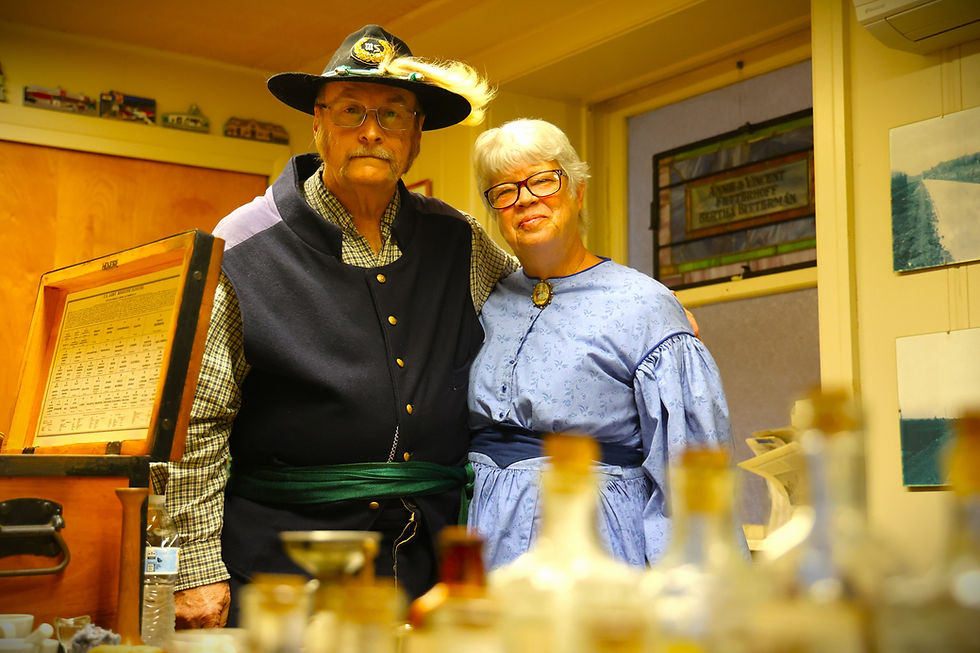
Robert Maurt and his wife during the April Program night. Photograph by Dylan Bowman.
Tales from the Past
Some of the greatest stories from the American Civil War are not of what the brave men had to face on the scorched and smoldering battlefields across our country, but rather inside the medical tents, where treatments, diseases, and lack of basic hygiene caused more than two-thirds of the deaths in those that died in America's bloodiest war.
In those tales, we hear of the ingenuity and bravery of those surgeons, doctors, nurses, and medical practitioners who used their knowledge and craft to ease the suffering of those that they could to the best of their ability. Last night, the Halifax Area Historical Society had the privilege of hosting Robert Marut, a Civil War surgeon reenactor, who broke down the many instruments of the trade at that time, the techniques used, and tales of victory and misery that came with them.

Robert Marut presents to a captive audience at the April Program. Photographs by Dylan Bowman.
The Doctor is IN.
Marut opened with a brief history of the first months of the Civil War...the tensions rising to their climax and the explosion of war throughout our nation starting in April 1861. From the beginning, surgeons and doctors were present to assist in the cause, but only a fraction of a FRACTION were available and active in the war effort at the front lines. At one point near the start of the war, there were only about 50 doctors for the entire Union army, a handful of hospitals that could house men in beds, and there were no ambulances.
Of course, as time passed and the war's carnage demanded that both sides in the conflict upgrade their facilities and number of active medical personnel, these numbers expanded. However, diseases such as diarrhea, dysentery, Typhoid Fever, Yellow Fever, malaria, measles, smallpox, pneumonia, tuberculosis, scurvy, and many more spread and were contracted in mass.
Horrific wounds were dealt with every day, and crude instruments like those seen in the photo above were used to amputate limbs, cauterize wounds, bind shredded flesh, and try to make the excruciating pain more bearable in the most privative of conditions. In other words, there was no easy-to-get and every-day-dose of pain killers for the majority of men who were injured or sick. It was up to the few doctors in the army to tend to these conditions to the best of their ability, and many times, though they were skilled in their profession, it was not enough.

Amputation being performed in a hospital tent, Gettysburg, July 1863. Photograph procured from National Archives (National Archives Identifier: 520203, Local Identifier: 79-T-2265.).
Another large point that Marut was sure to touch on was the mortality rate of soldiers and officers to contaminated surgical instruments, uncleaned surfaces, and disease-prone (or ridden) clothes, bandages, fluids, and other implements that were supposed to be of help and healing to the wounded and sick.
The saddest part...nearly no one knew about the true nature of germs at bacteria at the time.
A man who had been waiting to have his shredded leg amputated would be lifted onto a table pooled with blood and bits of bone, the procedure often done with no regard for the cleaning or sterilization of the instruments that were to be used to help save that soldier's life. Often, because of this lack of knowledge, many men died from post-surgery infections and diseases.
However, it is important to note that it was during the American Civil War that antiseptic surgeries began to be implemented. Joseph Lister was the first to begin applying the ideas of Louis Pasteur around 1865–1867, when he began using carbolic acid (phenol) to clean wounds and surgical instruments, dramatically reducing infections, and saving tens of thousands (ultimately hundreds of millions worldwide) of lives.

Visitors enjoy the April Program and spend time with members of the community. Photographs by Dylan Bowman.
For Those We Never Meet
Robert's presentation brought in 51 visitors, many of which I noticed were new faces. It was a joy to see the community's passion for the subject and the massive turnout that came from the event. The evening had a supremely healthy energy...too many more and the Society building would have had a line out the door!
And honestly, that brings me to a final piece of happiness I'd like to share: though our times be dark and the fight to reclaim the hearts of the general public in a desire to remember, honor, and cherish our shared past, there is a great deal of fervor still left in these small communities like Halifax. I think sometimes we just get discouraged because we think we are the only ones who care. Who take time to make a difference. Who step up for our communities. Fill in the blank. But there are many others out there.
We have a LOT of work to do, perhaps more than any one, or two, or even five generations can do in their lifetimes to make things right in our nation; getting people back to their roots. But there are places where that good American Spirit still shines out like a beacon, and I believe last night I saw a gleam of it.
Keep it shining. For those we hold close, and for those we will never meet.


Comments